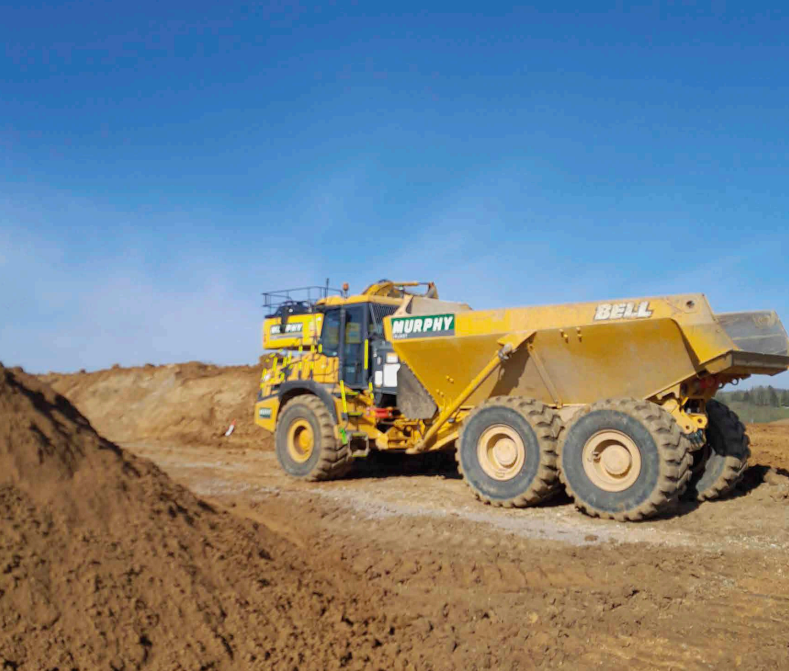
Lynch is supporting Murphy on critical Network Rail infrastructure works at Great Brington and Long Buckby Bridge. The primary focus at Long Buckby involves embankment regrading and bridge strengthening to enhance long-term stability and performance.
The works span from Area A to F along the northern edge of the track, with key activities including crest drainage installation between Areas B and E and regrading the embankment to reduce slope angles and improve structural integrity. Plant operations have been concentrated in Area F, located at the eastern end of the site.
Sustainability at Heart is one of Lynch’s core strategic pillars. We champion eco-friendly practices, social impact, fairness and integrity throughout everything we do. A key part of our sustainability commitment is our goal to achieve net-zero carbon emissions by 2040 (Scopes 1 & 2).
We are supporting our valued customer Murphy with ‘A Greener Murphy’, the ambitious Climate Action Plan to have net zero direct emissions by 2030.
As part of this commitment, Lynch has partnered with Murphy on a focused plant efficiency trial to reduce fuel use and carbon output on site. We supplied a 30-tonne Bell ADT, fitted with six Ultimate Cells, to capture accurate telematics data over a six-week period.
The aim was to assess real-world performance improvements and quantify the environmental benefits. This collaborative approach is one of many ways we are working together to drive sustainable innovation in construction.
This smart retrofit fuel cell technology optimises combustion engines by producing hydrogen on demand. It introduces small quantities of hydrogen into the engine air intake via electrolysis, in response to driver throttle commands. The technology is straightforward, requiring no hydrogen storage tanks in vehicles or on-site.
The unit can be scaled up to three or six cells, depending on the equipment needed. This patented device is designed to work with all types of fuels, including diesel, petrol, LPG, and ethanol, meeting both US and European standards.
Lynch supplied Murphy with a 30-tonne Bell Articulated Dump Truck (ADT), fitted with six Ultimate Cell units, to capture detailed telematics data over a six-week period.
Throughout the trial, weekly review meetings were held between Murphy’s Environmental team and Lynch’s Data and Sustainability team to track progress, review findings, and ensure consistency.
The performance of the trial machine was benchmarked in three key ways:
This multi-point comparison provided an accurate assessment of the trial machine’s efficiency and environmental impact.
During the trial, the test machine operated at a fuel burn rate of 9.4 litres per hour, compared to the control machines running at 12.9 litres per hour, a 31.3% improvement in efficiency.
The test machine consumed 1,179.7 litres of diesel and produced 3,102.6 kg of CO2, whereas the control machines used 1,619.0 litres and generated 4,258.0 kg of CO2.
Over 125.5 operating hours, this equated to a saving of:
Based on a standard working year of 260 days at 9 hours per day (2,340 total hours), we can project significant efficiency gains.
At the historic fuel consumption rate of 12.9 litres per hour, annual diesel use could reach 30,186 litres, producing 79,389 kg of CO2 and costing approximately £35,317.
By reducing consumption to 9.4 litres per hour, annual usage drops to 21,996 litres, generating 57,848 kg of CO2 at a cost of £25,935.
This results in a potential annual saving of: 8,190 litres of diesel, 21,541 kg of CO2, and £9,382 per machine.
8,190L
£9,382
FROM 21,541KG
From individual vehicles to large commercial fleets and industrial machinery, Ultimate Cell delivers measurable savings and sustainability benefits through proven hydrogen-on-demand technology.
Ready to improve fuel efficiency and reduce emissions in your operations? Let’s talk about how Ultimate Cell can support your goals.
Fill in our quick form or email us directly.